


1. TECHNICAL CONTEXT & SYSTEM EVOLUTION
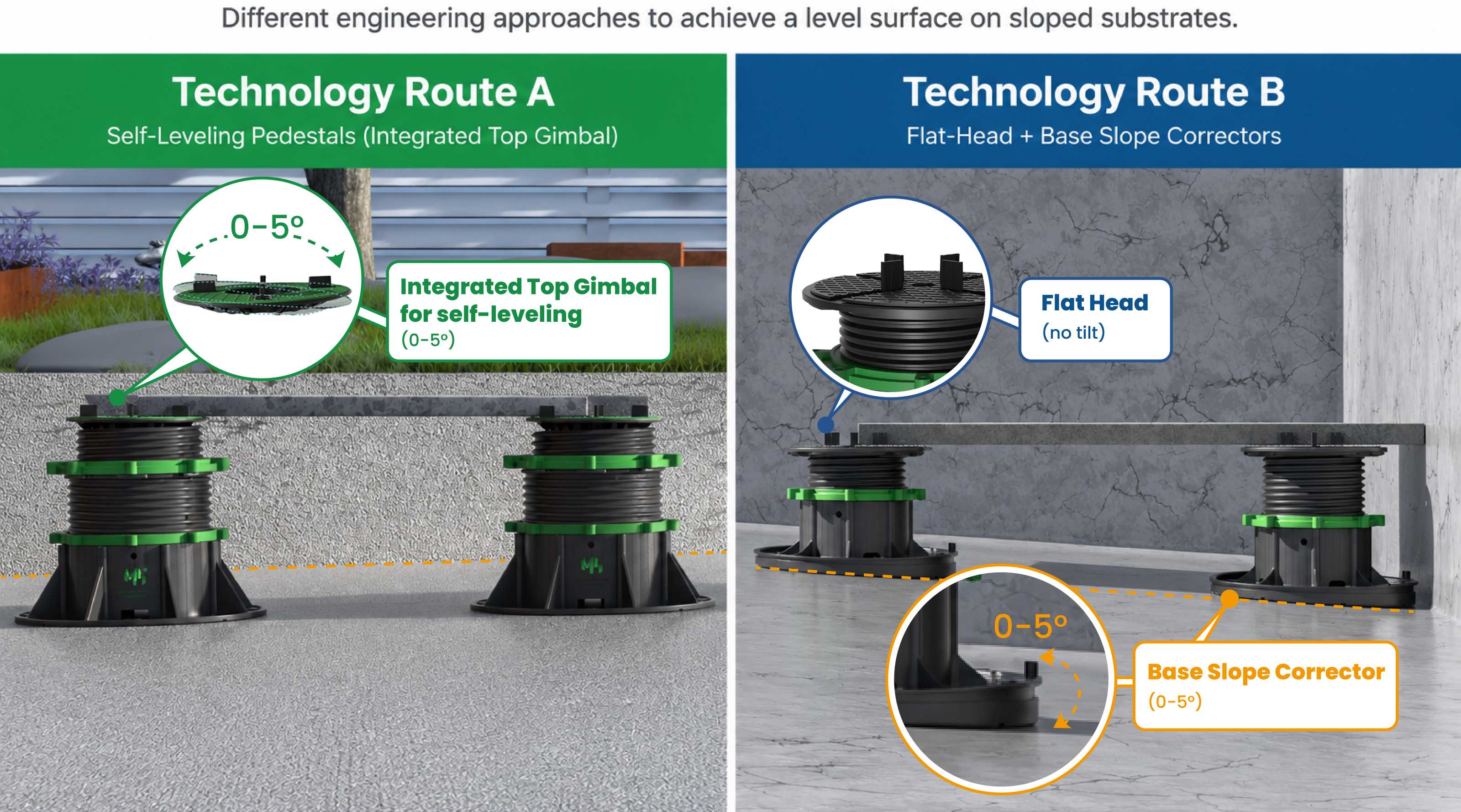
In contemporary outdoor paving, roof terrace construction, and commercial raised flooring projects, substructures must bridge structural drainage gradients (typically 0% to 5%) while establishing a dead-level finished surface. The global manufacturing and engineering sector has converged around two distinct technological philosophies:
Technology Route A: 1. Self-Leveling Pedestals: Integrated top gimbal joints for gravity-assisted slope compensation, engineered for maximum installation velocity and labor-hour reduction.
Technology Route B: 2. Standard Flat-Head + Base Slope Correctors: Integral rigid flat heads paired with rotating eccentric base wedge rings, engineered for rock-solid underfoot stiffness and low unit bill-of-material costs.
Neither product is universally superior; each is optimized for specific economic, structural, and architectural priorities. Delivering objective engineering insights into mechanical behavior and whole-of-life installed costs empowers clients to specify the ideal solution and eliminates post-installation disputes.
2. MECHANICAL MECHANISMS & STRUCTURAL PHYSICS
2.1 Self-Leveling Pedestal System
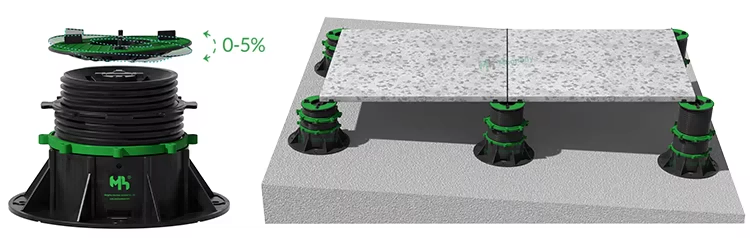
• Structural Composition: Employs a spherical ball-and-socket gimbal joint (Spherical Gimbal Mechanism) positioned between the head plate and threaded stem. The head articulates in all 360° directions to accommodate slopes ranging from 0% to 5%.
• Working Principle: Installers do not need to pre-measure slope gradients or align directional markers on the substrate. When heavy porcelain pavers or stone slabs are seated onto the head, the slab's dead weight automatically swivels the head until equilibrium is achieved, delivering instant leveling.
• Physics Behind the 'Damped / Slight Flex' Underfoot Sensation: Because the head sits on an active spherical pivot, it possesses rotational degrees of freedom. When an eccentric live dynamic load (e.g., a pedestrian's heel landing on a paver edge, jogging, or a concentrated chair leg) impacts the surface, the spherical joint experiences micro-angular displacement and polymeric damping deformation before reaching equilibrium. This physical response registers beneath the foot as a subtle, resilient 'cushioning flex' or 'micro-float'. It is not a structural failure, but an inherent kinetic attribute of ball-joint mechanics.
2.2 Standard Flat-Head Pedestal + Base Slope Corrector System
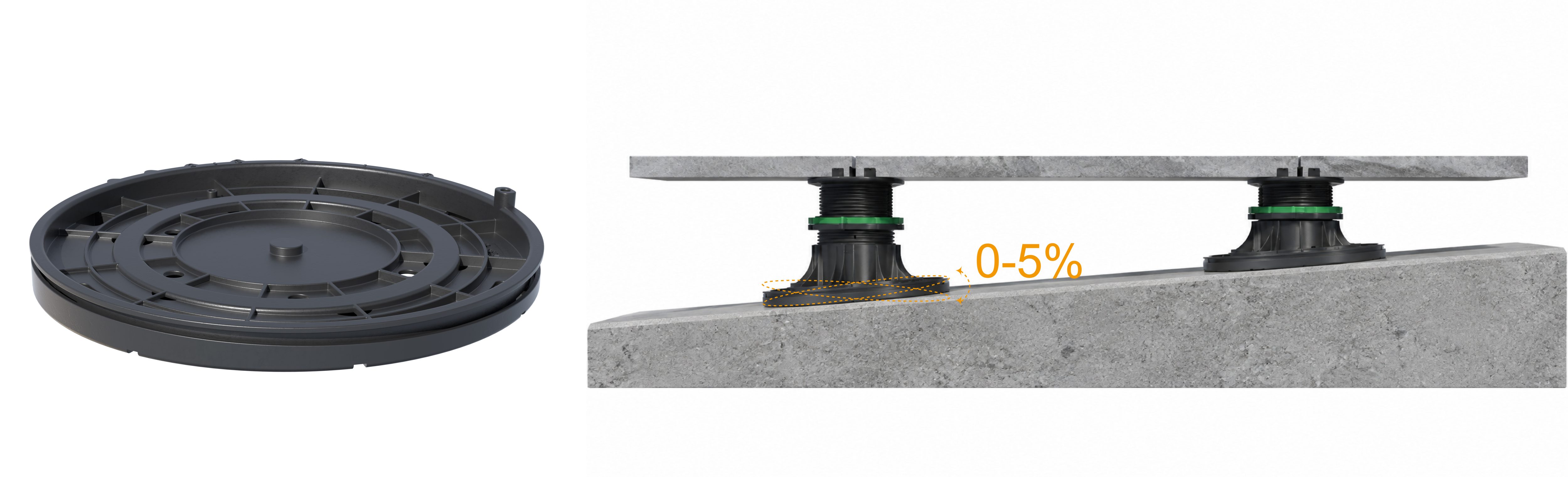
• Structural Composition: Features a one-piece, rigid, injection-molded horizontal head plate. Slope compensation is decoupled and handled at the bottom via an adjustable base unit featuring two counter-rotating eccentric wedge rings with calibrated percentage indicators (0% to 5%).
• Working Principle: Installers use digital spirit levels to measure substrate fall vectors and gradient percentages. They rotate the base corrector to the corresponding grade (e.g., 2.0%) and orient it along the fall line. The pedestal sits flush on the sloping slab while the central threaded stem projects vertically plumb.
• Physics Behind the 'Rock-Solid / Zero-Deflection' Underfoot Sensation: From the paver contact surface, head disc, heavy-duty threaded stem, through to the wide base plate, the entire load-bearing path forms a continuous, rigid, coaxial compression column with zero rotational degrees of freedom. Applied live loads translate 100% vertically into the substrate without angular distortion. Walking across the surface feels unyielding, solid, and identical to traditional ground-bonded masonry.
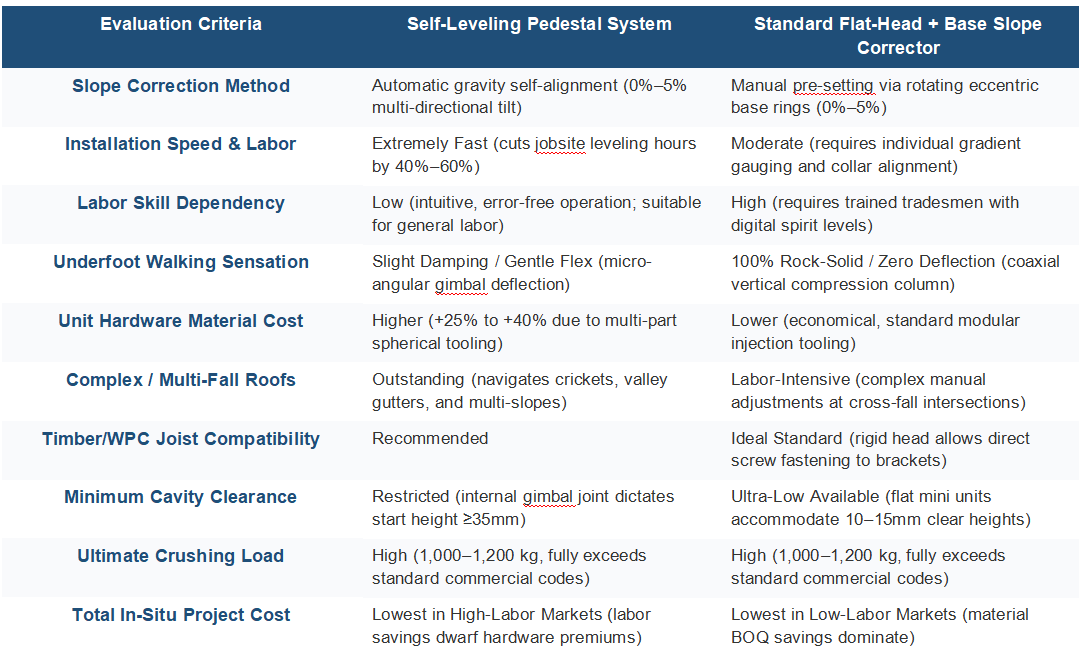
3. TECHNICAL & COMMERCIAL COMPARISON MATRIX
4. PROJECT SELECTION GUIDELINES ACROSS 5 CRITICAL SCENARIOS
4.1 Scenario 1: Regional Labor Cost Index (The Macro-Financial Driver)
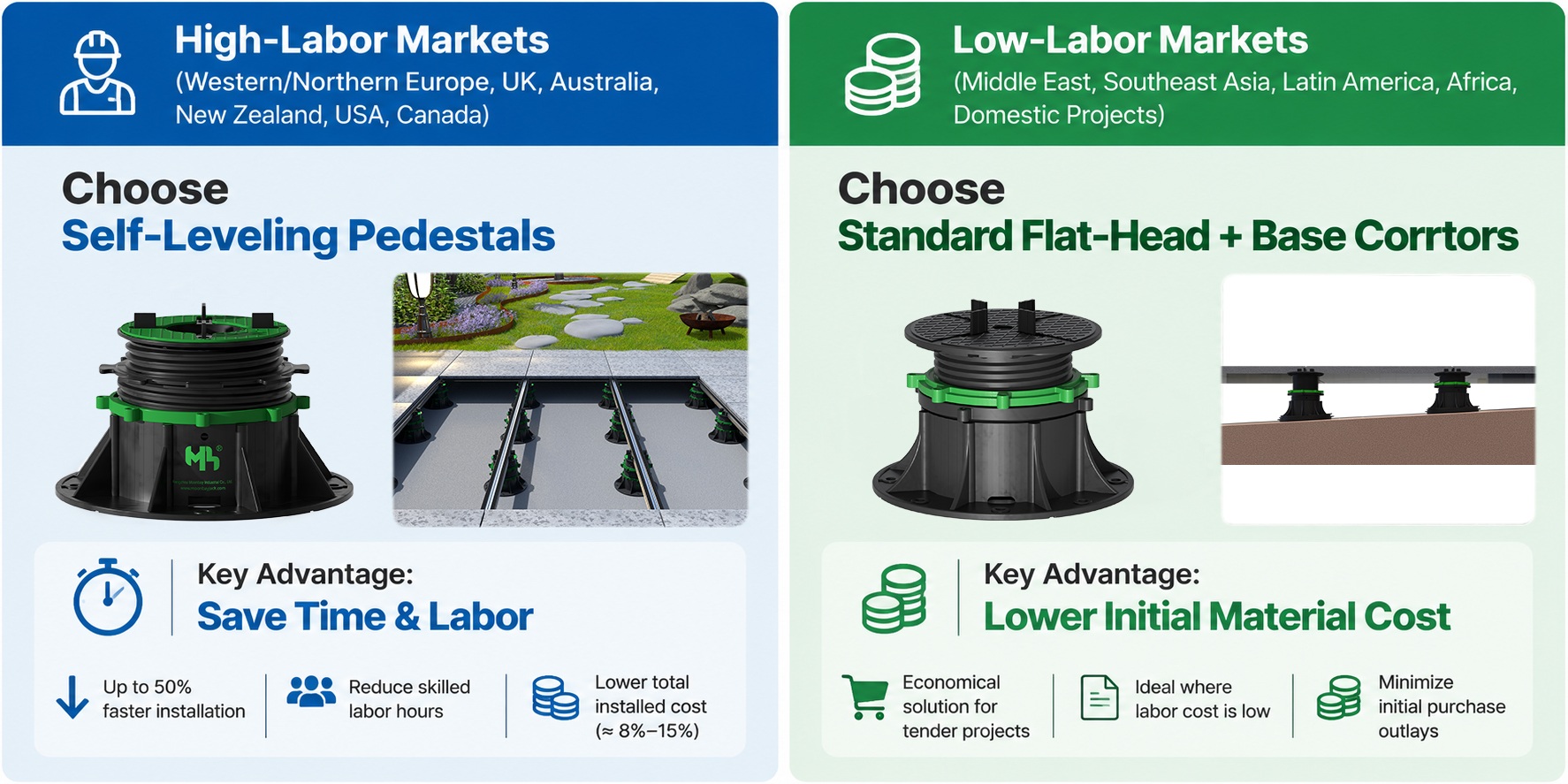
Procurement managers often fixate on unit purchase costs rather than Total In-Situ Project Costs. Demonstrating the net installed financial equation is critical:
• High-Labor Markets (Western/Northern Europe, UK, Australia, New Zealand, USA, Canada): MANDATE SELF-LEVELING PEDESTALS. In regions where skilled site installers earn $50 to $100+ per hour, eliminating individual slope measurements and manual collar dialing cuts installation hours by up to 50%. On a 500 m² terrace, saving dozens of skilled hours easily recovers the component price premium, resulting in an overall 8% to 15% reduction in total installed project cost.
• Low-Labor Markets or Material Budget-Constrained Tenders (Middle East, Southeast Asia, Latin America, Africa, Domestic Projects): SPECIFY STANDARD FLAT-HEAD + BASE CORRECTORS. In markets where labor is inexpensive but contractor bids are won on razor-thin initial material BOQs, flat-head systems minimize initial purchase outlays.
4.2 Scenario 2: Surface Flooring Material (Porcelain Pavers vs. Substructure Joists)
• Porcelain / Natural Stone Pavers (Point-Loaded Slabs): Fully compatible with both systems. Specify Self-Leveling for rapid execution and multi-fall slopes; specify
Flat-Head where clients demand zero-flex masonry firmness.
• Timber / WPC / Aluminum Decking Joist Systems: SUGGEST STANDARD FLAT-HEAD PEDESTALS WITH JOIST CRADLES.
4.3 Scenario 3: Substrate Drainage Gradient Topology
• Complex Multi-Directional Falls, Crickets, and Valley Gutters: SPECIFY SELF-LEVELING. When rooftop architecture features multiple drainage collection valleys, intersecting slopes, and geometric folds, manual base alignment becomes an error-prone nightmare. Installers frequently misalign slope vectors, creating stepped paver corners. Self-leveling spherical heads eliminate vector calculations entirely, neutralizing paver lippage automatically.
• Uniform Single-Directional Slopes (e.g., Constant 1.5% Fall): SPECIFY FLAT-HEAD + BASE CORRECTORS. On uniform rectangular podiums, all base correctors are pre-dialed to 1.5% and aligned along the same fall vector in batches, maximizing operational consistency and minimizing material expenditure.
4.4 Scenario 4: Occupancy Category & Traffic Volume
• High-Traffic Commercial Plazas, Transport Hubs, and Public Esplanades: SPECIFY FLAT-HEAD + BASE CORRECTORS. Heavy public pedestrian traffic, rolling luggage wheels, stiletto heels, and heavy outdoor planters demand zero perceptible deflection. The unyielding structural rigidity of the flat-head column reassures public users and project specifiers.
• Private Residential Terraces, Boutique Hotel Rooftops, and Wellness Decks: SPECIFY SELF-LEVELING. With lighter foot traffic, the subtle damping of the gimbal joint acts as an acoustic shock absorber, and rapid site rollout minimizes construction disruption to residents.
4.5 Scenario 5: Threshold Clearances & Low-Cavity Limits
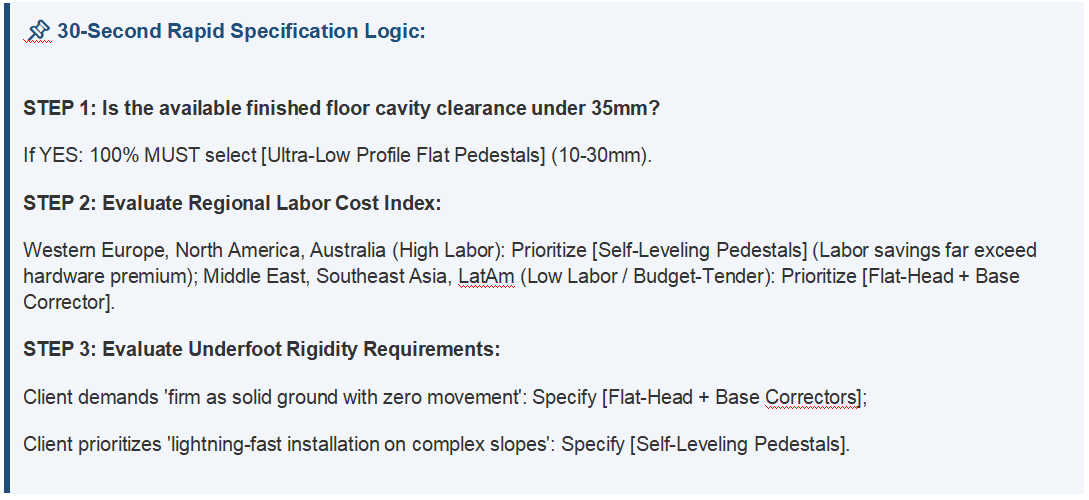
• Ultra-Low Threshold Clearances (15–35 mm Cavity Limits): MANDATE FLAT-HEAD MINI PEDESTALS. Because self-leveling heads require an internal ball-and-socket mechanism, they possess an irreducible physical height (typically ≥35 mm). When retrofitting older structures or working beneath low sliding-door weep holes, only ultra-low flat-head Mini pedestals (10–17 mm / 17–25 mm / 19–30 mm) can physically fit into the cavity.
5. 30-SECOND SELECTION DECISION TREE & SUMMARY


Mobile/WhatsApp:+ 86 176 8231 3725
ADD:Room B205, Cross-Border E-Commerce Comprehensive Pilot Area, No. 776 Jianshe 1st Road, Xiaoshan District, Hangzhou Zhejiang, China


Copyright: Hangzhou Moonbay Industrial Co., Ltd. @ 2021 record Technical support: xuanmeng network
 Home
Home

